Government employees in India often assume that leave rules are straightforward—apply, get approval, and move on. In reality, many employees unknowingly lose salary benefits, encashment value, or service advantages simply because they do not fully understand the difference between Casual Leave (CL), Earned Leave (EL), and Half Pay Leave (HPL). This confusion is common across Central Government services as well as State Government departments, including Assam.
Understanding leave rules is especially important today due to stricter digital attendance systems, leave account audits, and their growing linkage with salary, LTC, and retirement benefits. This guide is relevant for government job aspirants, serving employees, and even retirees who want clarity on how leave actually works.
This article explains CL, EL, and HPL in simple terms, focusing on rules, salary impact, and practical usage under Indian government service frameworks.
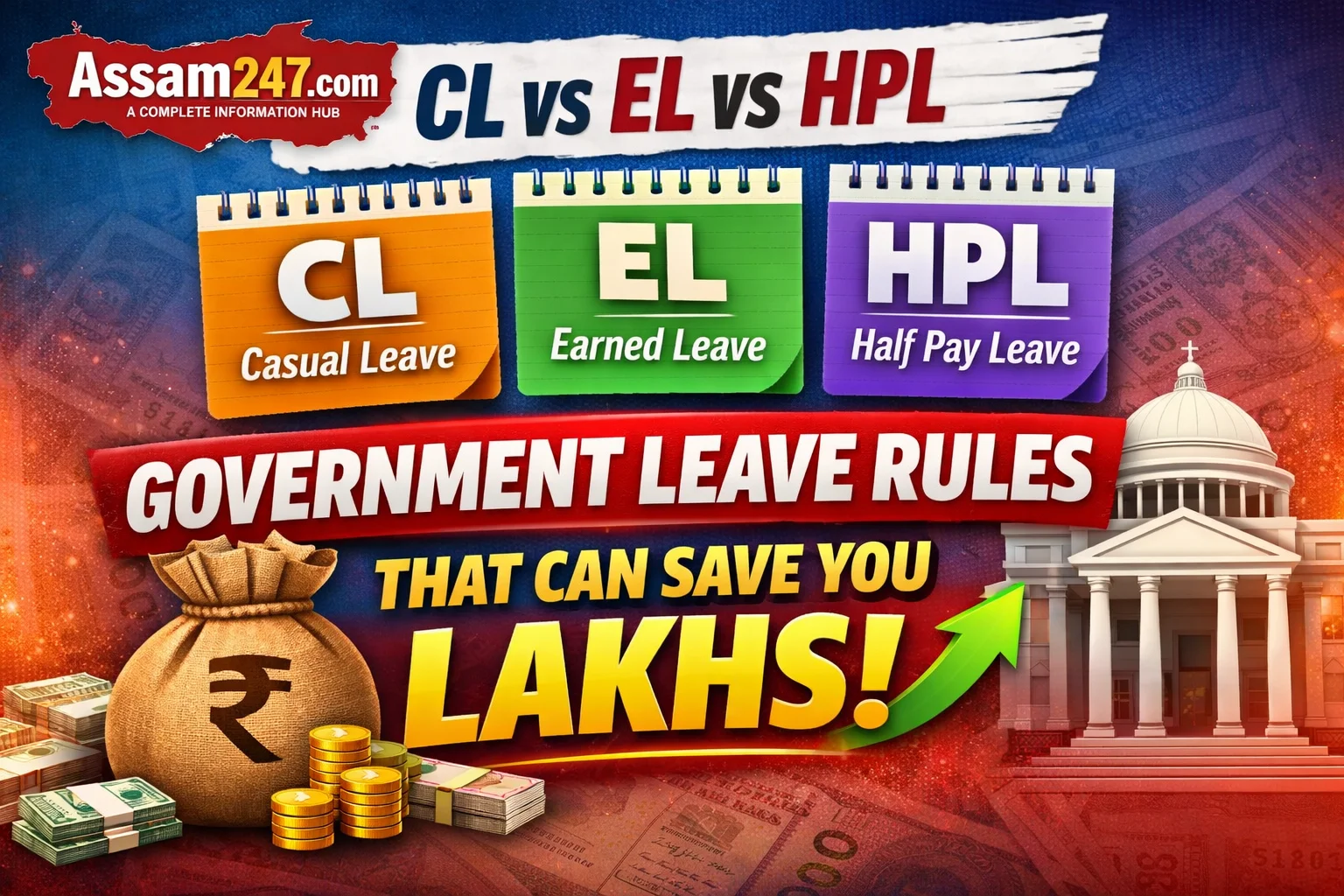
Quick Snapshot: CL vs EL vs HPL
| Leave Type | Full Form | Max Allowed (Typical) | Salary Impact | Carry Forward |
|---|---|---|---|---|
| CL | Casual Leave | 8–12 days/year | Full pay | ❌ No |
| EL | Earned Leave | Up to 300 days | Full pay | ✅ Yes |
| HPL | Half Pay Leave | 20 days/year | Half pay | ✅ Yes |
Exact limits may vary slightly by department or state rules.
What Is Casual Leave (CL)?
Casual Leave is meant for short, unforeseen personal needs such as family matters, minor emergencies, or urgent personal work. It is not intended for planned long absences.
Key Characteristics of CL
- Granted for casual or urgent reasons
- Usually limited to 8–12 days per calendar year
- Cannot normally be carried forward
- Fully paid leave
Common Uses
- Attending family functions
- Short personal errands
- Sudden domestic requirements
Rules Employees Often Miss
- CL is not a right, but a permission-based leave
- It is usually not combined with Earned Leave
- CL cannot be encashed
- Often restricted from being taken consecutively beyond a few days
Common Mistake:
Many employees assume unused CL adds up or has cash value. It does not.
What Is Earned Leave (EL)?
Earned Leave is the most valuable type of leave from a financial perspective. It is earned over time based on the period of service rendered.
How EL Is Earned
- Credited periodically (usually annually or half-yearly)
- Earned for days actually worked
- Accumulates over the service period
Key EL Rules
- Accumulation limit generally up to 300 days
- Can be encashed during LTC (as per rules)
- Encashable at retirement, resignation, or death
- Full salary is paid during EL
Why EL Matters Financially
Earned Leave directly affects your in-hand benefits at retirement, similar to how allowances under the 7th Pay Commission pay levels influence salary. For a deeper understanding, readers may also explore how pay and benefits are structured in government service through this detailed guide on how government salary is calculated in India (Basic Pay, DA, HRA & allowances) on Assam247.
Real Example
If an employee retires with 240 days of EL, they receive salary equivalent to 240 days based on last drawn basic pay plus applicable DA—often running into several lakhs.
What Is Half Pay Leave (HPL)?
Half Pay Leave is credited annually and is typically used for medical or long-duration personal needs.
Why Is It Called “Half Pay”?
- During HPL, the employee receives 50% of basic pay plus allowances
- Used when EL balance is low or preserved for future use
Conversion to Commuted Leave
- HPL can be converted into Commuted Leave
- In commuted leave, full salary is paid
- Requires a medical certificate
- Deducts double the HPL days from the leave account
Practical Usage
- Long-term illness
- Recovery periods
- Situations where EL is being preserved for retirement
CL vs EL vs HPL: Clear Comparison
| Aspect | CL | EL | HPL |
|---|---|---|---|
| Purpose | Short personal needs | Planned leave | Medical/long absence |
| Salary | Full | Full | Half |
| Encashment | ❌ No | ✅ Yes | ❌ No |
| Accumulation | ❌ No | ✅ Yes | ✅ Yes |
| Financial Value | Low | Very High | Moderate |
When Should You Use Which?
CL: For short, urgent matters
EL: For planned leave or financial advantage
HPL: For medical or long-duration needs when EL is limited
State Government Variations (Assam Focus)
Most State Government leave rules, including Assam Government services, broadly follow the Central Civil Services (Leave) Rules. However:
- Exact leave limits may differ
- Department-specific circulars may apply
- Digital leave systems may enforce stricter controls
Assam government employees should always cross-check their departmental notifications. Readers preparing for Assam-specific government roles can also stay updated through latest Assam government job and exam updates regularly published on Assam247.
Common Misunderstandings About Leave Rules
- “CL can be saved for later” – Incorrect
- “EL encashment is automatic every year” – Incorrect
- “HPL always reduces salary permanently” – Incorrect
- “Leave rules are same for all departments” – Incorrect
Impact on Students, Aspirants & Careers
For government job aspirants, understanding leave rules helps in:
- Interview preparation and service awareness
- Long-term career planning
- Evaluating job benefits beyond salary
Those preparing for competitive exams may find such service-rule clarity useful alongside practice through free mock tests and MCQ practice for APSC, ADRE, and Assam exams available on Assam247.
To stay updated with current affairs and practice related MCQs check out our current affair section.
Important Clarification
Leave rules are subject to:
- Government notifications
- Pay Commission recommendations
- Department-specific amendments
Employees are advised to verify details from official service rule books, department circulars, or official government portals before making financial or service-related decisions.
Official Sources & References
- Central Civil Services (Leave) Rules, Government of India
- Department of Personnel & Training (DoPT), Govt. of India
- Assam Government Service Rules (latest circulars)
Frequently Asked Questions (FAQs)
Q1. Can Casual Leave be carried forward?
No, CL lapses at the end of the calendar year.
Q2. Can Earned Leave be encashed every year?
Only under specific provisions such as LTC; otherwise, encashment is mainly at retirement.
Q3. Is Half Pay Leave better than Leave Without Pay (LWP)?
Yes. HPL ensures partial salary, while LWP gives none.
Q4. What happens to unused Earned Leave at retirement?
It is encashed up to the permissible limit.
Q5. Do Assam Government employees follow the same leave rules as Central employees?
Broadly yes, but minor variations exist. Always check official state circulars.
Final Takeaway
- EL is the most valuable leave financially
- CL is flexible but has no long-term benefit
- HPL is useful for medical needs
- Misusing CL or ignoring EL accumulation can lead to losses
- Understanding leave rules is as important as understanding salary
For a deeper understanding of how leave links with pay, allowances, and DA, readers may also explore this comprehensive explainer on Dearness Allowance (DA) in India and its impact on government salaries available on Assam247.