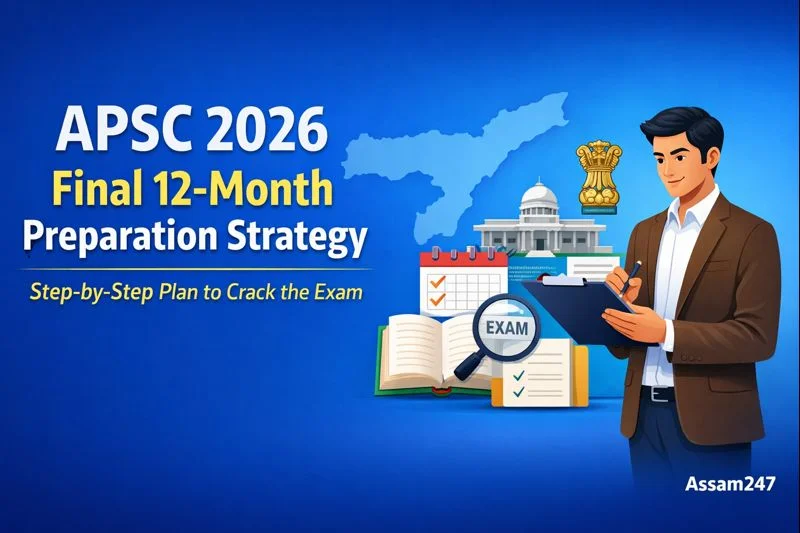
Introduction: The Road to Assam’s Premier Civil Services
The Assam Public Service Commission (APSC) Combined Competitive Examination (CCE) represents one of the most prestigious and challenging career pathways in Northeast India. Each year, thousands of aspirants compete for a limited number of Group A and B positions—roles that shape policy, implement governance, and directly impact Assam's development trajectory. The difference between success and disappointment often lies not in intelligence or dedication alone, but in strategic, structured preparation.
This comprehensive guide provides a detailed, month-by-month battle plan for APSC 2026 aspirants. Whether you're a fresh graduate, a working professional balancing commitments, or someone attempting the exam for the second time, this roadmap will transform your preparation from chaotic to systematic, from anxious to confident.
Why 12 Months? The Science Behind Strategic Preparation
Neuroscientific research on learning indicates that distributed practice—spreading study sessions over time—leads to significantly better long-term retention than cramming. A 12-month framework allows for:
- Foundation Building (3 months): Creating mental schemas for complex topics
- Practice & Application (6 months): Developing exam-specific skills
- Revision & Mastery (3 months): Achieving automatic recall under pressure
Studies of successful APSC candidates reveal that those following structured plans typically score 20-25% higher in both Prelims and Mains compared to unstructured preparation. The psychological benefit is equally important: reducing last-minute stress and building sustained motivation.
Understanding the APSC CCE: More Than Just an Exam
Before diving into the preparation strategy, let's understand what we're preparing for. The APSC CCE is conducted under the authority of the APSC Act, 1937 and selects candidates for prestigious positions including:
- Deputy Commissioner/Collector
- Assistant Commissioner
- Superintendent of Police (in various departments)
- Block Development Officer
- And other Class I & II services
The Three-Tier Selection Process:
- Preliminary Examination (Objective Type): 400 marks, qualifying in nature
- Main Examination (Descriptive Type): 1500 marks
- Personality Test/Interview: 275 marks
Crucial Insight: While Prelims is qualifying, the Mains and Interview together determine your final ranking. Many candidates make the mistake of over-focusing on Prelims and under-preparing for the subsequent stages. For comprehensive interview preparation, start early. Our detailed guide on how to introduce yourself in interviews and common interview questions can help you prepare effectively.
The Complete 12-Month APSC 2026 Preparation Timeline
Phase 1: Foundation & Conceptual Clarity (Months 1-3)
The Goal: Build a robust understanding of all subjects from the ground up.
Week 1-4: The NCERT Anchoring Method
- Begin with NCERTs from Class 6-12 for History, Geography, Polity, and Economy
- Create color-coded notes—use blue for concepts, red for facts, green for examples
- Daily Routine: 4 hours of reading + 1 hour of note-making + 30 minutes of revision
Pro Tip: Read chapters backward—start with questions, then summaries, then the content. This primes your brain to seek specific information.
Week 5-8: Standard Reference Books Integration
- Polity: Laxmikanth's "Indian Polity"—read with the Indian Constitution Explained article open for cross-reference
- Geography: Majid Husain and Goh Cheng Leong, supplemented with current environmental issues
- History: Bipin Chandra for modern India, supplemented with Indians Who Have Won the Nobel Prize for cultural history context. Also explore The Nobel Prize history and selection process for contemporary relevance.
- Economy: Ramesh Singh, focusing on chapters relevant to Assam's economy
- Check the list of best books for APSC preparation suggested by Toppers
Week 9-12: Assam-Specific Foundation
- Assam Year Book 2025-26: Read cover to cover, creating a separate notebook
- Assam's Geography: Physical features, climate, rivers, and biodiversity (link to National Parks of India for conservation context)
- Assam's History: Ancient, medieval, and particularly the colonial and post-independence periods
- Current Affairs Initiation: Start with Assam Budget 2025-26 analysis and Advantage Assam 2.0 Summit 2025 outcomes
- Foundation Phase Hack: Use the Feynman Technique—after studying a topic, explain it in simple terms as if teaching a 12-year-old. Record yourself and listen back to identify gaps in understanding.
Phase 2: Prelims-Focused Practice (Months 4-6)
The Goal: Transition from knowledge acquisition to exam-oriented application.
Month 4: Subject-Wise MCQs Mastery
- Daily target: 100 MCQs across subjects
- Use the comprehensive MCQ Practice – 3000+ Free Questions platform
- Focus on high-yield topics first:
- Indian Polity: Fundamental Rights, DPSP, Constitutional Amendments
- Economy: Budget terms, inflation indices, government schemes
- Assam GK: Culture, festivals, important personalities, current schemes
Error Analysis: Maintain a digital error log using Google Sheets with columns for: Date, Topic, Error Type (conceptual/factual/silly), and Action Taken
Month 5: Speed and Accuracy Development
- Introduce timed tests: 30 questions in 30 minutes
- Practice elimination techniques: Learn to eliminate 2 options confidently even when unsure of the right answer
- Current Affairs Integration: Link static knowledge with current events. For example, when studying environmental policies, connect to Purnima Devi Barman's conservation work and recent environmental summits. Also understand President's Rule in India for polity sections.
- Weekly Mock Tests: Take every Sunday as a full-length Prelims mock from Free Daily Mock Tests platform
Month 6: Full-Length Simulation & Gap Analysis
- Week 1-2: Alternate between subject-wise and full-length tests
- Week 3: Identify 3 weakest topics and dedicate entire days to mastering them
- Week 4: Attempt 5 full-length mocks under strict exam conditions
Advanced Technique: Learn "educated guessing" through probability analysis of previous years' answer patterns
Prelims-Specific Resources:
- Previous Year Papers (2015-2024): Analyze trend lines for question distribution
- Government Websites: PIB, PRS, Assam Government portals for authentic information
- Monthly Current Affairs Compilations: From at least two reliable sources
Phase 3: Mains Preparation & Answer Writing (Months 7-9)
The Goal: Develop the ability to articulate knowledge in structured, persuasive writing.
Month 7: The Art of Answer Writing
Days 1-15: Learn the structure:
- Introduction: Context setting (3-4 lines)
- Body: Divided into logical paragraphs with headings
- Conclusion: Forward-looking, optimistic (3-4 lines)
Days 16-30: Practice 2 answers daily with strict adherence to word limits
Critical Skill: Learn to rephrase the question in your introduction—this demonstrates comprehension
Month 8: Optional Subject Mastery & Essay Crafting
- Optional Subject: Dedicate 3 hours daily. Create topic-wise notes and previous year question compilations
- Essay Writing: Practice different styles—argumentative, analytical, descriptive
- Integration Technique: Weave in references to:
- Assam Government Schemes 2026 for state-specific examples
- Uniform Civil Code debates for constitutional discussions
- Treaties Between India and Pakistan for international relations answers
- Waqf (Amendment) Bill, 2025 for contemporary legal discussions
- Join a Peer Group: Exchange and evaluate 2 essays weekly with fellow aspirants
Month 9: Comprehensive Mains Simulation
Weekday Schedule:
- Morning (3 hours): GS Paper I/II answer writing
- Afternoon (3 hours): Optional subject
- Evening (2 hours): Revision and current affairs
Weekends: Full-length mains papers (3 papers on Saturday, 2 on Sunday)
Special Focus: Master data interpretation for economy questions and map-based questions for geography
Mains Enhancement Tools:
- Digital Tools: Use our Free Form Fillup Tools for image optimization and document management
- Knowledge Repository: Regularly visit Knowledge Enhancement section for updated study materials
- Answer Writing Platforms: Enroll in at least one online evaluation program
Phase 4: Integrated Revision & Test Series (Months 10-11)
The Goal: Achieve seamless integration between Prelims and Mains preparation.
The 3-2-1 Revision Protocol:
- 3: Revise each topic at least 3 times before the exam
- 2: Use at least 2 different sources for important topics
- 1: Create 1-page summaries for each major subject
Month 10: Cyclic Revision System
- Week 1-2: GS Revision Cycle 1
- Week 3: Optional Subject Intensive
- Week 4: Current Affairs Consolidation (last 18 months)
Daily Routine: 60% revision, 40% new practice
Innovative Method: Create audio notes of important facts and listen during commute/exercise
Month 11: Grand Test Series
- Week 1-2: Alternate between Prelims and Mains mocks
- Week 3: Focus exclusively on weak areas identified through mock analysis
- Week 4: Simulation Week—recreate exact exam day conditions
Performance Metrics: Track not just scores but:
- Time per question
- Accuracy rate
- Question selection strategy
- Stamina and focus endurance
Special Attention Areas:
- Assam-Specific Content: Revisit Assam's political developments, Special Intensive Revision (SIR) electoral process, and cultural landmarks including prominent figures like Zubeen Garg and his cultural impact
- National Issues: Understand implications of 8th Pay Commission discussions, BRICS expansion, and G7 Summit 2025 outcomes. Also study global economic issues like potential tariff wars and their impact.
- Science & Technology: Keep updated on topics like ISRO's PSLV missions and AI in healthcare
Phase 5: Final Polishing & Interview Prep (Month 12)
The Goal: Peak at the right time with confidence and composure.
Week 1-2: Precision Revision
- Study only from your own notes and flashcards
- Practice rapid revision techniques: 1 hour per subject revision
- Take light mocks to maintain rhythm without fatigue
- Health Focus: Begin sleep cycle adjustment and nutrition optimization
Week 3-4: Interview Preparation Intensive
- Self-Analysis: Complete a thorough self-assessment using the STAR method (Situation, Task, Action, Result)
- DAF (Detailed Application Form) Mining: Every hobby, achievement, and preference is potential interview material
- Current Affairs Mastery: Be prepared to discuss:
- Assam's economic trajectory post-Advantage Assam 2.0
- National security and international relations developments
- Technological advancements like AI in Healthcare and their governance implications. Also understand consumer tech like CNAP feature and mobile operating systems comparison.
- Global Recognition: Know about achievements like Sherry Singh Mrs Universe 2025 and 2025 Nobel Prizes for cultural and scientific discussions
- Mock Interviews: Minimum 5, with varied panel styles (friendly, aggressive, indifferent)
Last 7 Days: The Tapering Protocol
- Day 1-3: Revise only the most important 50 topics
- Day 4-5: Light revision, focus on diagrams and flowcharts
- Day 6: Administrative preparation—hall ticket, ID, exam center visit
- Day 7: Complete mental rest, visualization exercises
Advanced Preparation Techniques for Working Professionals
If you're balancing a job with APSC preparation, consider this modified approach:
The 4-Hour Daily Strategy:
- Early Morning (5-7 AM): High-concentration tasks—answer writing, difficult concepts
- Commute Time: Audio lectures, current affairs and related MCQ practice and podcasts
- Lunch Break (30 minutes): MCQ practice on mobile
- Evening (8-10 PM): Revision and note-making
- Weekends: 8-10 hours with full mock tests
Efficiency Multipliers:
- Digital Notes: Use cloud-synced notes accessible on all devices
- Micro-learning: Break topics into 15-minute chunks
- Weekday-Weekend Linkage: Weekdays for input, weekends for output (tests, answer writing)
Career & Salary Insights
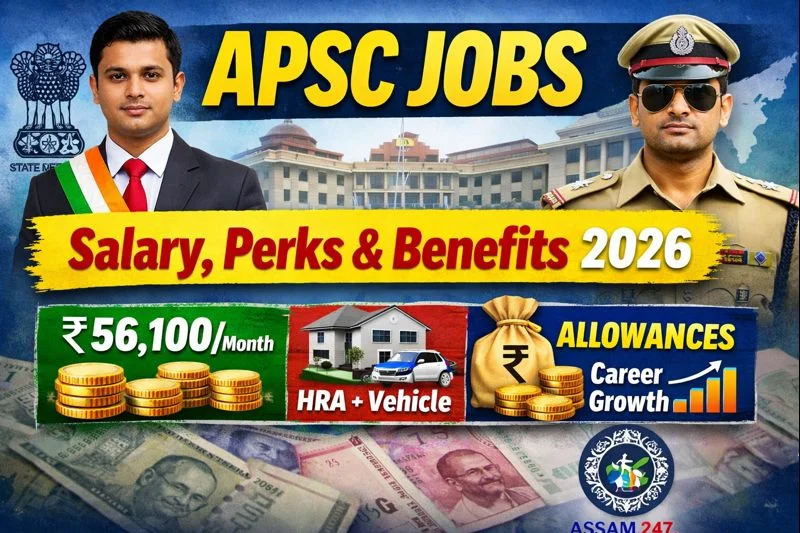
Understanding the career trajectory can be highly motivating. After clearing APSC, you'll join the Group A services with attractive remuneration. Study the Assam Government Salary Structure and understand how government salary is calculated. Learn about Dearness Allowance calculations and the 7th Pay Commission pay levels to understand your future compensation structure.
Exploring Alternative Career Paths
While preparing for APSC, it's also wise to be aware of other opportunities. Explore career opportunities after 12th for broader educational context and emerging sectors like the semiconductor industry in India for alternative career paths.
Mental Health & Sustainability Practices
The 90-Minute Focus Block:
- Study 90 minutes, break 20 minutes
- During breaks: Physical movement, no screens
- 4 blocks daily = 6 hours of quality study
Stress Management Toolkit:
- Weekly Digital Detox: 24 hours without social media/exam discussions
- Physical Anchor: Daily 30-minute exercise regardless of schedule
- Support System: One non-aspirant friend/family member for perspective
Energy Management:
- Identify your chronotype (morning/evening person)
- Schedule difficult subjects during peak energy times
- Use low-energy times for revision/mechanical tasks
Technology Integration for Smart Preparation
Essential Digital Tools:
- Note-taking: OneNote or Notion for searchable, organized notes
- Current Affairs and Related Mock Tests: Regular practice on Assam247's Free Weekly Current Affairs and Mock Tests
- Mock Tests (Subject-Wise): Regular practice on Assam247's Free Daily Mock Tests
- Study Planner: Google Calendar with color-coded subjects
- Flashcards: Anki or Quizlet for spaced repetition
Automation Strategies:
- Set up Google Alerts for "Assam Government Schemes," "APSC Updates"
- Use RSS feeds from PRS, PIB, and Assam government sites
- Create automated backup for all study materials
Common Pitfalls & Course Correction
Mistake 1: Ignoring Mains During Prelims Preparation
Correction: From Month 1, dedicate 30 minutes daily to answer writing practice
Mistake 2: Over-collecting Resources
Correction: Limit to 1-2 standard books per subject + current affairs compilation
Mistake 3: Neglecting Health
Correction: Fixed sleep schedule, weekly off, balanced diet
Mistake 4: Isolated Preparation
Correction: Join a study group (physical or virtual) for motivation and perspective
Mistake 5: Not Analyzing Mocks
Correction: Spend at least equal time analyzing as taking the mock
The Final Word: Beyond the Exam
Remember that APSC preparation is not just about clearing an exam—it's about preparing for a career in public service. The knowledge you gain, the discipline you develop, and the perspective you build will serve you throughout your administrative career.
As you progress through this 12-month journey, regularly visit Assam247.com for Latest Job & Exam Updates and check all exams to stay informed about notifications and changes. Explore our detailed article on Group A, B, C & D Government Jobs to understand the career trajectory you're working toward. Learn about the different posts and their salary structure for APSC qualified candidates here
Your success in APSC 2026 will be determined by three factors:
- Consistency over intensity
- Strategy over hard work alone
- Resilience over momentary setbacks
Begin today. The first step in your 12-month journey is the most important. Create your schedule, gather your resources, and commit to the process. The administrative service of Assam awaits its next generation of leaders—let that include you.
Important Note: While this guide is comprehensive and based on analysis of successful candidates' strategies, always verify information with official sources. Regularly check the APSC Official Website for notifications, and remember that cut-offs vary annually based on multiple factors. This guide provides a framework—your dedication and adaptability will determine the outcome.