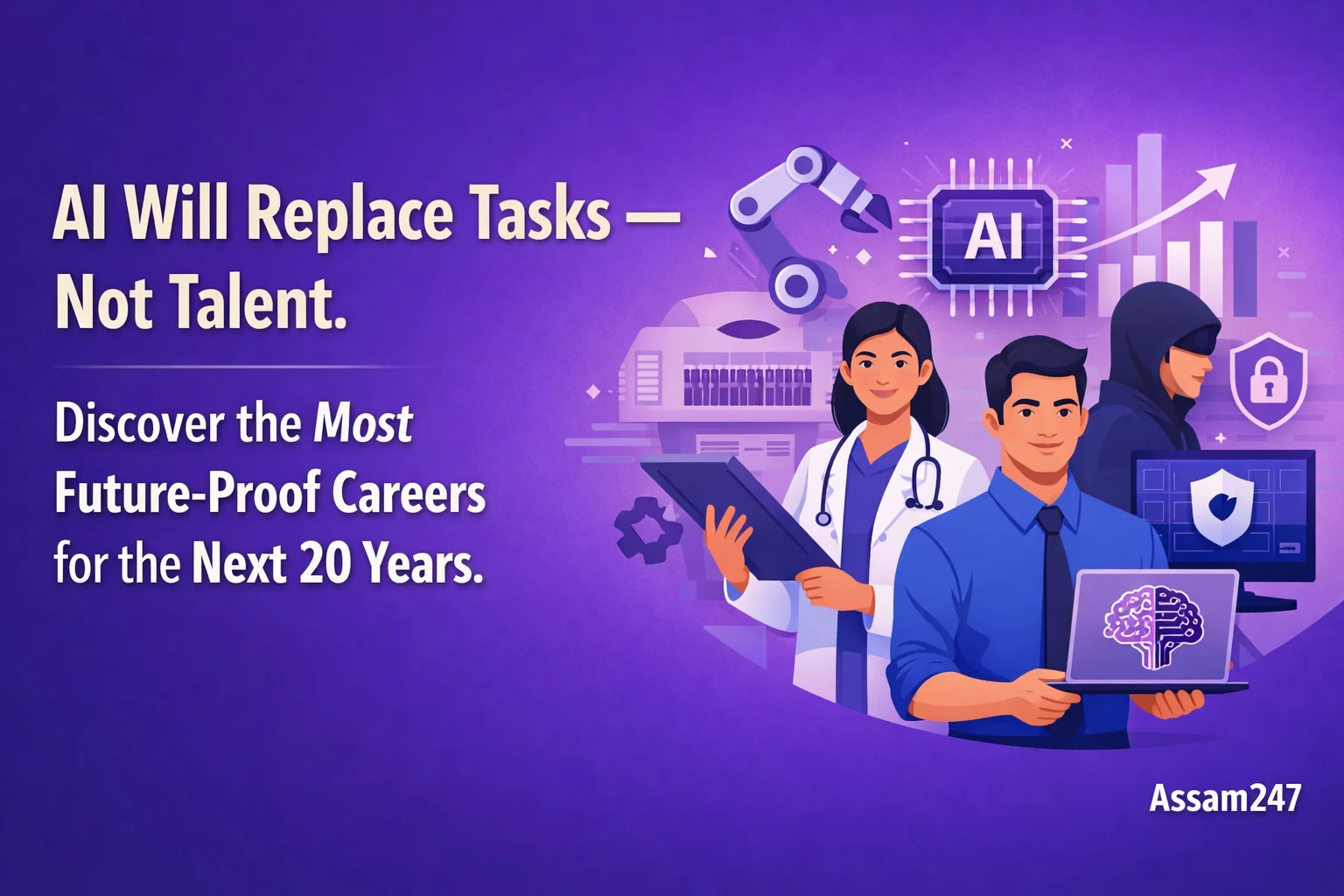
Artificial Intelligence (AI) is no longer a futuristic concept; it is rapidly transforming the global job market, including India’s govement, private, and technology sectors. From automated customer support and AI-assisted medical diagnosis to smart goveance and precision agriculture, intelligent systems are increasingly performing tasks once handled exclusively by humans. India has formally recognized AI as a strategic growth area through national initiatives like Digital India and policy frameworks from NITI Aayog.
For students, competitive exam aspirants, and early-career professionals, this transformation creates both significant opportunity and understandable uncertainty. Which careers will remain stable? What should students study today to build a secure and prosperous future over the next 10–20 years?
This comprehensive guide provides a research-based, future-focused roadmap. It explores AI-resistant careers, future-proof educational pathways, and the essential skills that will remain valuable even as automation advances, with special relevance for students in India, including Assam and the Northeast.
What Is Artificial Intelligence (AI)?
Artificial Intelligence (AI) is when computers or machines are made to think and lea like humans. They can understand things, solve problems, and make decisions. Artificial Intelligence refers to computer systems designed to perform tasks that typically require human intelligence. According to the OECD and UNESCO, AI systems use machine leaing models and data-driven algorithms to improve their performance over time.
Example
A good example of AI is Alexa, made by Amazon, or Siri, made by Apple.
When you say:
“Alexa, play music,”
Alexa understands your voice and plays the music for you.
Normally, computers only do what humans tell them step-by-step. But with AI, computers can lea from experience and act smart.
Think of it like this:
-
🧠 Human brain: You lea from your teacher and remember things.
-
💻 AI computer: It leas from data and remembers pattes.
For example:
-
You lea to recognize your friend’s face.
-
AI leas to recognize faces in photos.
So, AI makes machines smart, so they can help us in many ways, like talking, playing games, driving cars, or helping in hospitals.
If you're interested in how AI is already reshaping medicine and diagnostics, you can explore our detailed guide on Artificial Intelligence in Healthcare: Transforming the Future in 2026.
Key AI technologies include:
-
Machine Leaing (ML): Algorithms that lea from data.
-
Deep Leaing: A complex subset of ML using neural networks.
-
Natural Language Processing (NLP): Enabling computers to understand and generate human language.
-
Computer Vision: Allowing machines to interpret and understand the visual world.
-
Robotics and Autonomous Systems: Building intelligent machines that can perform tasks in the real world.
Why This Matters: Understanding AI’s Dual Impact on Careers
Technological change is not new, but AI is different because it automates cognitive tasks, directly impacting white-collar roles. The World Economic Forum’s Future of Jobs Report highlights two simultaneous trends: some routine jobs will decline, while new, high-skill technology-driven roles will expand.
Key trends expected between 2026 and 2036:
-
Routine jobs will decline: Roles involving repetitive and rule-based tasks are most vulnerable.
-
Technical and analytical jobs will grow: Demand for AI engineers, data scientists, and cybersecurity experts will soar.
-
Hybrid careers will dominate: The safest roles will combine deep domain expertise with AI proficiency.
-
Human-centric skills will be paramount: Creativity, critical thinking, empathy, and ethical judgment will become even more valuable.
-
Cybersecurity demand is projected to grow due to digital risks.
-
Healthcare and research sectors show sustained human involvement.
Students who understand these trends and adapt early will have a significant advantage. AI will not eliminate all jobs—but it will profoundly change how work is done.
For students preparing for competitive exams where technology and current developments are increasingly tested, regularly following Current Affairs & Govement Exam Updates can give a crucial edge.
The Safest Havens: Careers Least Likely to Be Replaced by AI (2025–2045)
1. AI and Technology Professionals (The Architects of AI)
This is the most secure career category because AI systems cannot design, maintain, or improve themselves without human engineers.
-
Why It’s Safe: These professionals are responsible for designing AI models, training ML systems, ensuring accuracy, monitoring for bias, and preventing failures.
-
Key Roles: AI Engineer, Machine Leaing Engineer, Data Scientist, AI Research Scientist, Software Engineer, Cloud Engineer.
Students exploring adjacent emerging tech industries may also consider reading our complete guide on Career Opportunities in the Semiconductor Industry in India (2026).
2. Healthcare Professionals (The Healers)
AI can assist with diagnostics and data analysis, but it cannot replicate the human touch required for care.
-
Why It’s Safe: The profession demands physical examination, deep ethical responsibility, emotional intelligence, and complex decision-making.
-
Key Roles: Doctors, Surgeons, Nurses, Psychologists, Physiotherapists.
Students exploring medical or interdisciplinary careers can also explore career planning insights after 12th through
Career Opportunities After 12th (Arts, Science & Commerce)
3. Cybersecurity Professionals (The Defenders)
As AI increases our reliance on digital systems, the risks from cybercrime also grow exponentially.
-
Why It’s Safe: AI can help detect threats, but strategic response and security architecture design require human judgment.
-
Key Roles: Cybersecurity Analyst, Ethical Hacker, Security Engineer.
4. Engineering and Infrastructure Roles (The Builders)
These careers involve designing, building, and maintaining complex physical systems.
Students inspired by India’s scientific achievements can explore our deep analysis of PSLV and ISRO’s Recent Mission Insights to understand real-world engineering complexity.
-
Key Roles: Civil Engineers, Mechanical Engineers, Electrical Engineers, Robotics Engineers.
These roles require physical-world application, safety validation, and innovative design beyond automation.
5. Govement and Administrative Services (The Administrators)
Govement jobs remain among the most secure careers in India.
If you're planning for state civil services, you should read:
For understanding long-term financial security in govement roles, also explore:
6. Teachers and Education Professionals (The Mentors)
AI can assist with lesson delivery, but teaching remains deeply human. It cannot replace mentorship, moral guidance, classroom management, or human motivation.
Students exploring broader academic pathways after school can read:
Career Opportunities After 12th (Arts, Science & Commerce)
7. Scientific Research Careers (The Discoverers)
Original scientific inquiry requires curiosity and breakthrough thinking. AI assists analysis but does not independently generate original scientific breakthroughs.
To understand global scientific recognition, explore:
8. Creative and Design Professionals (The Creators)
AI can generate content templates, but originality and cultural depth remain human strengths.
Strong communication and presentation skills are critical in creative careers. You may find value in:
9. Skilled Technical and Physical Professions (The Makers)
Hands-on professions require adaptability and on-site problem-solving that automation still struggles with.
Examples:
-
Electricians
-
Surgeons
-
Mechanics
-
Construction Engineers
Robotics cannot yet fully replicate adaptability in unstructured physical environments.
10. Hybrid Professionals (The Most Future-Proof Category)
This is the safest long-term strategy: combining domain expertise with AI literacy.
-
A doctor using AI for diagnostic support.
-
An engineer using AI for design automation.
-
A lawyer using AI for compliance research.
-
A teacher using AI for personalized leaing plans.
Your Educational Roadmap: What to Study for a Future-Proof Career
Your Strategy for Success in the AI Era
Artificial Intelligence will reshape the job market, but it will not eliminate the need for skilled, ethical, and creative human professionals.
The safest careers will involve:
-
Technology expertise
-
Deep human interaction
-
Critical and ethical judgment
-
Genuine creativity and innovation
-
Govement jobs
The ultimate strategy is not to avoid AI, but to understand it, embrace it, and integrate it into your professional skillset.
In a rapidly changing world, consistent preparation, awareness of policy changes, and continuous skill-building will define long-term success.
- For those targeting public sector careers, regularly tracking Latest Assam & India Govement Job Updates and exploring All Competitive Exams in Assamcan help you plan strategically.
- To strengthen preparation, refer to: Best Books for APSC Exam 2026.
- Students exploring broader academic pathways after school can read: Career Opportunities After 12th (Arts, Science & Commerce)
- Students exploring adjacent emerging tech industries may also consider reading our complete guide on Career Opportunities in the Semiconductor Industry in India (2026).
Frequently Asked Questions (FAQs)
1. Which careers are safest from AI in India?
Careers safest from AI include AI engineering, cybersecurity, healthcare (doctors, nurses), govement services, teaching, scientific research, and engineering. These roles require human judgment, creativity, and complex decision-making.
2. Which course is best for a future-proof career in India?
The best courses include:
-
B.Tech in Computer Science, AI, or Data Science
-
Cybersecurity and Cloud Computing
-
MBBS and healthcare degrees
-
Engineering (Civil, Mechanical, Electrical)
-
Semiconductor and Robotics programs
These fields will remain in high demand over the next 20 years.
3. Will AI replace govement jobs in India?
No. AI may automate clerical tasks, but govement roles involving administration, policy-making, law enforcement, and public welfare will continue to require human professionals.
4. What skills should students lea to stay safe from AI job loss?
Students should develop:
-
Programming and digital skills
-
Critical thinking and problem-solving
-
Communication and leadership
-
Creativity and innovation
-
Adaptability and continuous leaing
Combining technical skills with human skills provides the strongest job security.
5. Is coding enough to secure a future career?
No. Coding alone is not enough. Students should combine programming with mathematics, system design, domain expertise, and real-world problem-solving skills.
6. Which jobs are most at risk from AI automation?
High-risk jobs include:
-
Data entry operators
-
Tele-callers
-
Routine clerical jobs
-
Basic bookkeeping
-
Repetitive coding and content writing
Students in these fields should upgrade their skills.
7. How can students in Assam prepare for AI-era careers?
Students should focus on:
-
Strong foundation in Mathematics and Computer Science
-
Leaing programming languages like Python
-
Preparing for govement and technical exams
-
Following current affairs and technology trends
-
Building practical skills through projects and inteships